

Concrete flooring can serve very different purposes depending on the condition of the slab and how the space will be used.
Some Orange County properties need damaged concrete repaired. Others need an uneven slab prepared for new flooring. Warehouses and commercial spaces may benefit from polishing, while homeowners and retailers may prefer stained or decorative finishes.
Understanding the differences between these concrete flooring options can help you choose the right approach before work begins.
What Types of Concrete Flooring Are Available?
Concrete flooring is not a single product or finish.
Common options include:
- Polished concrete
- Stained concrete
- Self-leveling concrete
- Concrete floor repair
- Grinding and surface preparation
- Warehouse and industrial flooring
- Decorative concrete finishes
The best option depends on the existing slab, traffic levels, desired appearance, budget, and intended use of the property.
Polished Concrete Flooring
Polished concrete turns an existing slab into the finished flooring surface through mechanical grinding, honing, and polishing.
Diamond abrasives are used progressively to refine the concrete until the desired finish is achieved.
Depending on the project, polished concrete can have:
- A matte appearance
- Satin finish
- Semi-gloss finish
- High-gloss finish
- Minimal aggregate exposure
- More visible exposed aggregate
You can learn more about professional polished concrete flooring for residential, commercial, and industrial properties.
Where Does Polished Concrete Work Best?
Polished concrete is commonly used in:
- Warehouses
- Retail stores
- Offices
- Restaurants
- Showrooms
- Garages
- Industrial facilities
- Residential interiors
Its durability and relatively straightforward maintenance make it especially useful in high-traffic environments.
The existing slab should still be evaluated before polishing. Cracks, damaged joints, coatings, adhesives, pitting, or contamination can affect both the process and final appearance.
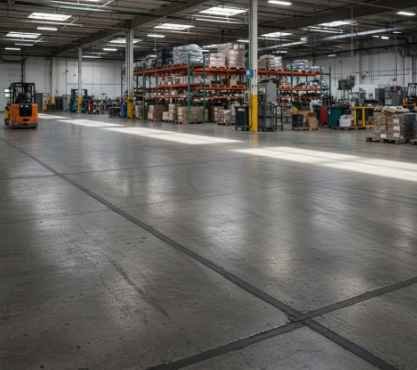
Benefits of Polished Concrete
Durability
Concrete can handle substantial daily traffic when the underlying slab is in suitable condition.
This makes polished floors practical for properties where carts, equipment, vehicles, customers, or employees regularly move across the floor.
Simple Maintenance
Polished concrete generally does not require routine waxing.
Removing abrasive dirt and cleaning the surface with appropriate products can help preserve the finish.
Design Flexibility
Concrete can be polished at different sheen levels and combined with stains or other decorative treatments.
Light Reflectivity
Higher-polish surfaces can reflect natural and artificial light, helping interiors appear brighter.
Uses the Existing Slab
In many projects, the structural concrete already present in the building becomes the finished floor rather than being covered by another flooring material.
Stained and Decorative Concrete
Concrete flooring does not have to remain its natural gray color.
Stains, dyes, scoring, exposed aggregate, and other decorative techniques can change the appearance while retaining the character of the concrete.
Property owners interested in color can explore stained polished concrete for homes and commercial spaces.
Possible design options include:
- Earth-tone stains
- Contemporary colors
- Multiple-color designs
- Decorative scoring
- Borders
- Patterns
- Different aggregate exposure levels
- Matte through high-gloss finishes
Concrete varies naturally, so exact color uniformity should not always be expected.
What Is Self-Leveling Concrete?
Self-leveling concrete or self-leveling underlayment is used to create a smoother, more consistent surface over an existing substrate.
It can help address low areas and uneven surfaces before installing certain finished flooring materials.
Common applications include preparation for:
- Tile
- Vinyl flooring
- Carpet
- Wood flooring
- Some coating systems
- Other finished flooring products
It should not be viewed as a universal solution for every uneven slab.
The existing floor must first be inspected to determine why it is uneven and whether self-leveling material is appropriate.
For more information about the process and suitable applications, see our self-leveling concrete service information.
Does Self-Leveling Concrete Make a Floor Perfectly Level?
Not necessarily.
The term “self-leveling” can make the material sound as though it automatically corrects every elevation problem.
In reality, successful installation depends on:
- Surface preparation
- Primer
- Substrate condition
- Product selection
- Installation depth
- Mixing
- Environmental conditions
- Contractor technique
Some floors may also require grinding, patching, repair, or other preparation before self-leveling material is installed.
How Long Does Self-Leveling Concrete Take to Dry?
Drying and cure times depend on the specific product, thickness, temperature, humidity, substrate, and flooring system being installed afterward.
Some products allow limited foot traffic relatively quickly, but that does not necessarily mean the surface is ready for every type of flooring installation.
Always follow the manufacturer’s specifications for the product being used.
Concrete Floor Repair
Even strong concrete can develop damage.
Common concrete flooring problems include:
- Cracks
- Spalling
- Pitting
- Damaged joints
- Uneven sections
- Worn surfaces
- Previous coating failure
- Surface contamination
The right repair depends on what caused the problem and how the floor will be used afterward.
Professional concrete floor repair may involve crack treatment, patching, grinding, joint repair, resurfacing, or other surface preparation.
Why Repair Concrete Before Polishing or Refinishing?
Damaged concrete can affect the finished appearance and performance of a floor.
Before polishing, staining, coating, or installing another flooring system, a contractor should evaluate:
- Crack movement
- Loose concrete
- Surface deterioration
- Old adhesives
- Existing coatings
- Moisture concerns
- Damaged joints
- Oil or chemical contamination
Repairing these conditions first creates a better foundation for the final flooring system.
Can Cracked Concrete Still Be Polished?
Often, yes.
The presence of cracks does not automatically mean the entire floor must be replaced.
A contractor should first determine whether the cracks are stable and what caused them.
Some cracks can be repaired before polishing, although repaired areas may remain visible afterward.
Concrete polishing itself does not repair structural movement.
Concrete Grinding and Surface Preparation
Grinding is an important part of many concrete flooring projects.
It may be used to:
- Remove old coatings
- Remove adhesive residue
- Correct certain high spots
- Prepare concrete for polishing
- Open the surface before another treatment
- Remove weak or contaminated surface material
Grinding should be matched to the needs of the floor. Significant settlement or structural movement cannot necessarily be corrected simply by grinding the surface.
Concrete Flooring for Warehouses and Industrial Properties
Warehouse floors must handle conditions that residential floors rarely experience.
These may include:
- Forklift traffic
- Pallet movement
- Heavy equipment
- Repeated impacts
- High foot traffic
- Abrasion
- Oils or chemicals
- Constant joint crossings
For these environments, contractors need to consider durability, downtime, maintenance requirements, repair needs, and how quickly the floor must return to service.
Polished concrete can be particularly useful when a facility wants to continue using its existing concrete slab as the finished flooring surface.
Concrete Flooring for Homes
Concrete flooring can also work well in residential properties.
Common applications include:
- Garages
- Living areas
- Kitchens
- Home offices
- Additions
- Basements
- Modern open-plan interiors
Residential projects tend to place greater emphasis on color, finish, comfort, and overall interior design.
Rugs, furniture, lighting, and surrounding materials can all influence how a polished or stained concrete floor feels within the room.
Concrete Flooring for Retail and Commercial Spaces
Retailers, restaurants, salons, offices, and showrooms often need flooring that combines appearance with durability.
Polished and stained concrete can provide:
- Modern appearance
- Color customization
- High-traffic durability
- Relatively simple cleaning
- Different sheen levels
Businesses can also incorporate patterns, scoring, or decorative treatments to coordinate the floor with the overall space.
Which Concrete Flooring Option Is Right for Your Property?
Start with the condition of the existing slab.
A contractor should determine whether the floor needs:
- Repair
- Grinding
- Leveling
- Coating removal
- Polishing
- Staining
- Decorative treatment
- More extensive restoration
After the slab has been evaluated, you can choose the flooring approach based on how the space will be used and the appearance you want.
Questions to Ask a Concrete Flooring Contractor
Before starting a project, ask:
What condition is the existing slab in?
The contractor should inspect rather than assume the floor is ready for finishing.
What preparation is required?
Ask whether coatings, adhesives, damaged material, cracks, or uneven areas must be addressed first.
What will the finished floor look like?
Discuss gloss, aggregate exposure, color, repairs, and natural variation.
How long will the project take?
Timing depends on the size of the floor, preparation requirements, repairs, products used, and final flooring system.
When can the floor return to service?
Walking on the floor and returning it to full commercial or vehicle traffic may have different timelines.
What maintenance will be required?
Maintenance should be explained before the project is complete so you understand how to protect the finished surface.
Frequently Asked Questions About Concrete Flooring in Orange County
Is Polished Concrete Good for Commercial Buildings?
Yes. Polished concrete is commonly used in warehouses, restaurants, retail stores, offices, showrooms, and industrial properties because it can handle substantial traffic while remaining relatively easy to maintain.
Can Existing Concrete Be Refinished?
Often, yes. Existing slabs can frequently be repaired, ground, polished, stained, or prepared for another flooring material.
The condition of the slab determines which options are appropriate.
Do Concrete Floors Have to Be Gray?
No. Stains, dyes, aggregate exposure, scoring, and decorative treatments can significantly change the appearance.
Is Concrete Flooring Low Maintenance?
Polished concrete generally has straightforward maintenance requirements, although the exact routine depends on the finish, traffic, and environment.
Can Uneven Concrete Be Fixed Without Replacing the Slab?
Sometimes. Grinding, patching, self-leveling materials, and other methods can address certain elevation problems.
The cause and severity of the unevenness should be determined first.
How Long Can Concrete Flooring Last?
A properly installed and maintained concrete flooring system can provide many years of service. Actual lifespan depends on slab condition, traffic, environment, installation, and maintenance.
Choosing Concrete Flooring in Orange County
Concrete floors can be repaired, leveled, polished, stained, or prepared for another flooring system depending on the needs of the property.
The most important first step is determining what condition the existing concrete is in rather than selecting a finish based only on appearance or price.
Concrete Solutions works with residential, commercial, warehouse, and industrial concrete floors throughout Orange County.
If you are considering concrete repair, polishing, staining, leveling, or another flooring solution, contact Concrete Solutions to request an evaluation and estimate.
